
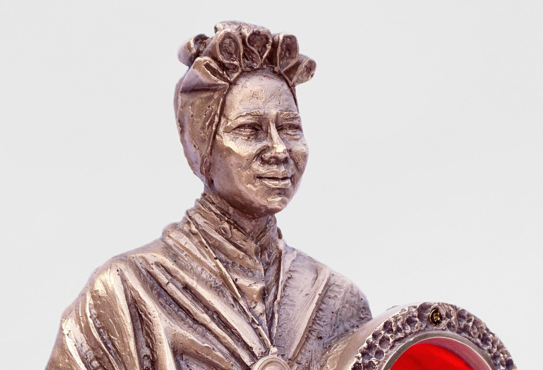
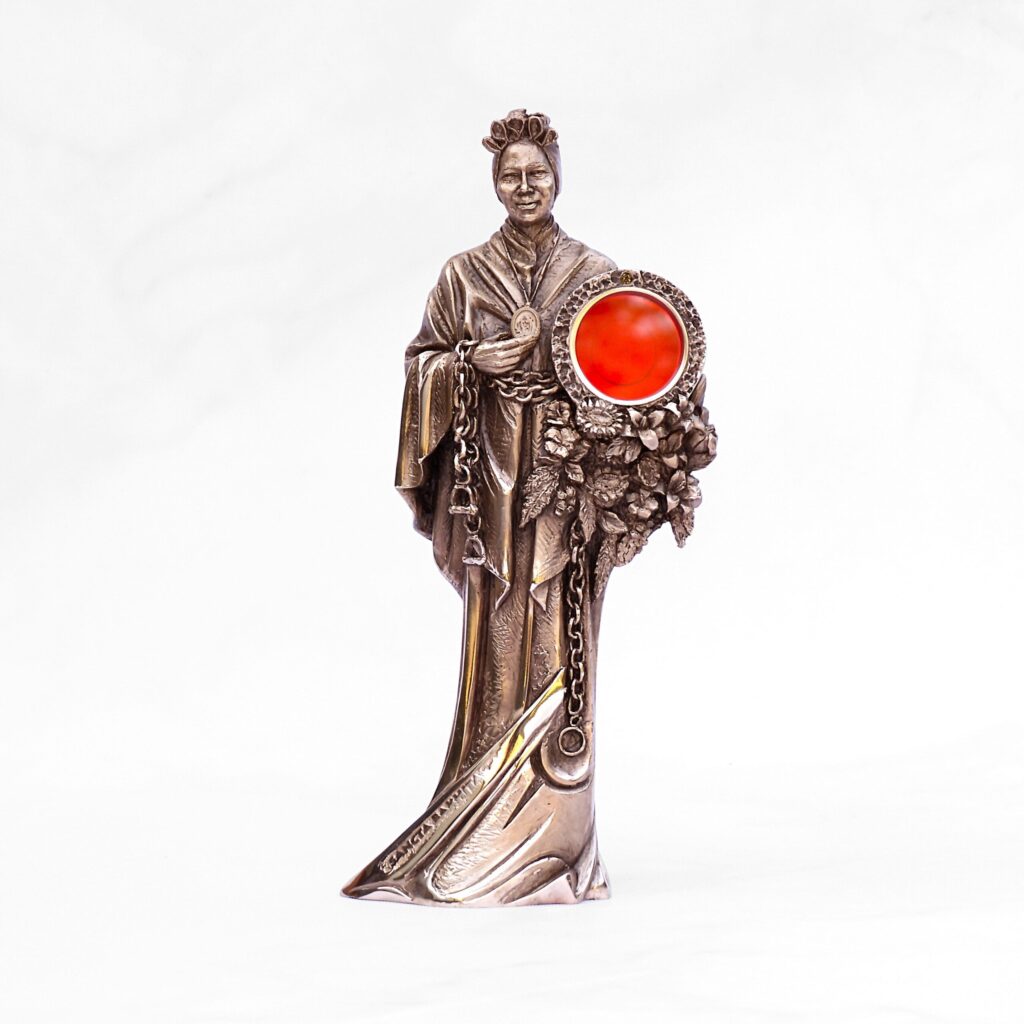
One of our latest projects is Saint Josephine Bakhita reliquary. We created a reliquary of this saint for the first time, for the Franciscan Monastery in Warsaw. This commission began our closer acquaintance with Saint Josephine Bakhita. Because she is an extraordinary woman and an equally extraordinary saint, we decided to write more about her.
A Brief History of Josephine Bakhita
Josephine Bakhita was a Sudanese woman who lived at the turn of the 20th century.
When she was a little girl, while her parents were working in the fields, she was kidnapped by Arab slave traders. She was taken to cruel slavery twice, where she was beaten and humiliated.
In 1883, she was bought by the Italian consul, Callisto Legnani, who took her to Italy. It was the beginning of a changes in her life. She became a nanny for the family of Marina Turina Michieli.
After several years, she found the Congregation of the Sisters Daughters of Charity, Servants of the Poor of St. Magdalene of Canossa. She joined this congregation, where she spent over 50 years, serving as a cook, seamstress, laundress, and porter. During World War II, she cared for the wounded.
She died with a reputation for holiness on February 8, 1947 – we celebrate her liturgical memorial that day.
Bakhita means “Happy”.
I lived a very happy and carefree life, without suffering– Josephine said of her childhood. This little girl, surrounded by love, was torn from her family when she was about 7 (or maybe 8). Why don’t we give the precise date? Terrible events in the life of that little girl caused her to forget her birth year and her real name. She was named Bakhita, which means “happy” or “lucky” in Arabic.
Baptism and Name Change.
On January 9, 1890, her former Arabic name, Bakhita, became her surname after she was baptized. She was given the names Josephine Margaret Fortunata. On the same day, she also received her First Holy Communion and the sacrament of Confirmation.
“Happy” in the Words of the Popes
Pope Benedict XVI recalled her life story in the encyclical “Spe Salvi” and John Paul II, in his homily during the canonization Mass, said:
In today’s world, thousands of women continue to fall victim to injustice, even in developed, modern societies. In Saint Josephine Bakhita, we see a wonderful advocate of true emancipation.
Miracles Through the Intercession of Saint Josephine Bakhita.
Just three years after the saint’s death, the Canossian Bulletin published the names of those who received graces through her intercession. Is was six pages fragment of this document.
One of the miraculous healings was that of a Brazilian woman with diabetes who was facing leg amputation. Through the intercession of Józefa Bakhita, she was healed.
Josephine Bakhita reliquary from Art Studio Urszula Szczepaniak
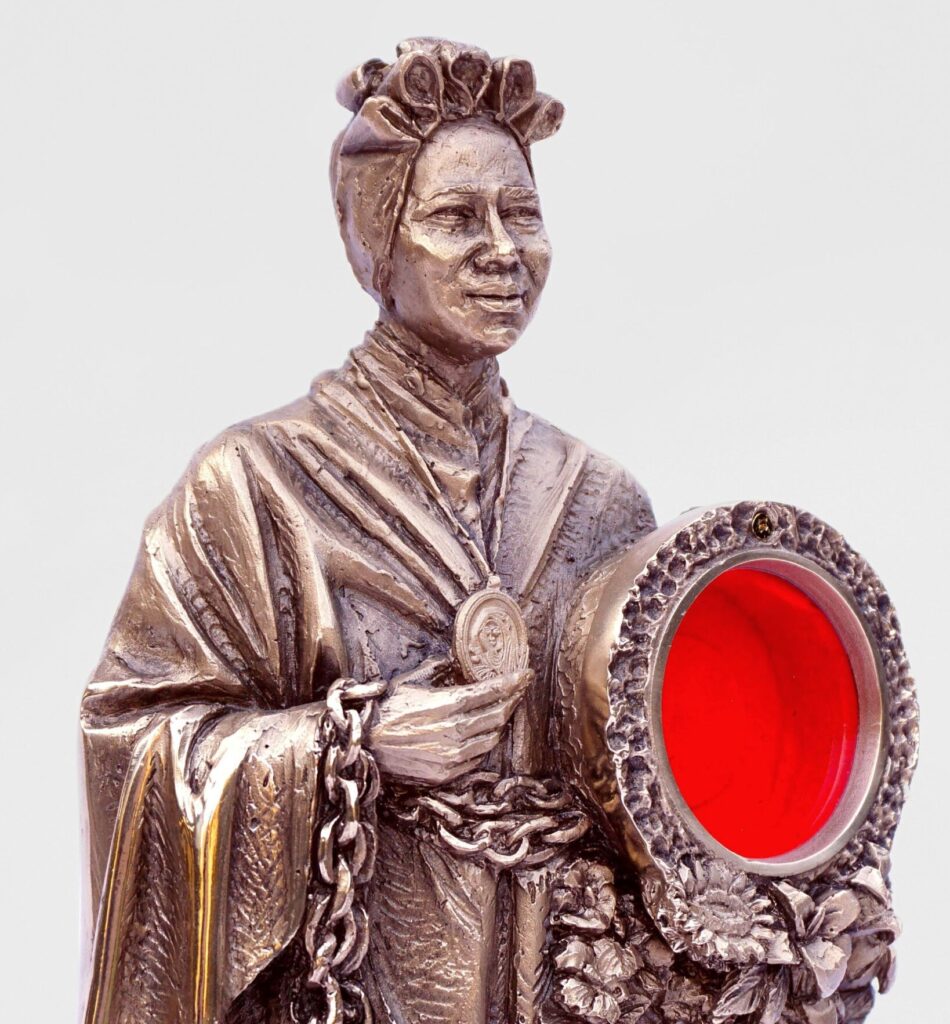
A reliquary is a small sculpture used to preserve the relics of saints (fragments of flesh, hair, or fabrics that have come into contact with their bodies). In addition to universal cross-shaped reliquaries, we also create figures of saints or blesseds. This was the case with the reliquary of Saint Josephine.
The Symbolism of Bakhita Reliquary
While working on the reliquary, we sought to capture the most important symbols associated with the saint. Josephine consecrated herself to the Mother of God. She received the medallion and the blue ribbon of the Daughters of Mary. Therefore, we depicted her on the reliquary with the medallion around her neck. However, this is not the only symbol of this saint. The other symbol is a chain around her figure, symbolizing slavery.
The reliquary, like the other products available in our store, is small. It stands 30 cm high and is cast in bronze, like all the reliquaries made in our studio.
The Saint Bakhita Reliquary: A Spiritual Inspiration for the Artist.
When I design and create sacred sculptures and reliquaries, I strive to capture the inner strength and beauty of the saint. The same situation was with Bakhita. She became a source of inspiration for me.
I was particularly moved by the change that occurred in Bakhita’s life. From a slave, that is, a victim of violence, she became a witness to God’s love. Seeing the baptismal font, she kissed it and said: Here I have become a child of God.
I often think back to her words:
If I were to meet those who kidnapped me, or even those who tortured me, I would stand on my knees and kiss their hands. Because if that hadn’t happened, I wouldn’t be a Christian and a nun today…
Josephine Bakhita is not only the patron saint of Sudan, but also of all persecuted Christians. Her feast day falls on February 8th, The International Day of Prayer and Awareness Against Human Trafficking
The reliquary of St. Josephine Bakhita is available in our online store. You can also find reliquaries of other saints and blessed there.
See the Bakhita reliquary in the store online:
Bibliography:
https://deon.pl/wiara/jozefina-bakhita-to-moja-swieta-na-nowy-rok-wylosuj-swojego-patrona,2704109
https://hozana.org/pl/swiety/jozefina-bakhita
https://www.ekai.pl/jozefina-bakhita-swieta-niewolnica/
https://stacja7.pl/swieci/jozefina-bakhita-swieta-niewolnica/
https://hozana.org/en/saints/saint-josephine-bakhita
https://voxdomini.pl/archiwa/swieci-i-ich-dziela/sw-jozefina-bakhita-1869-1947/
