
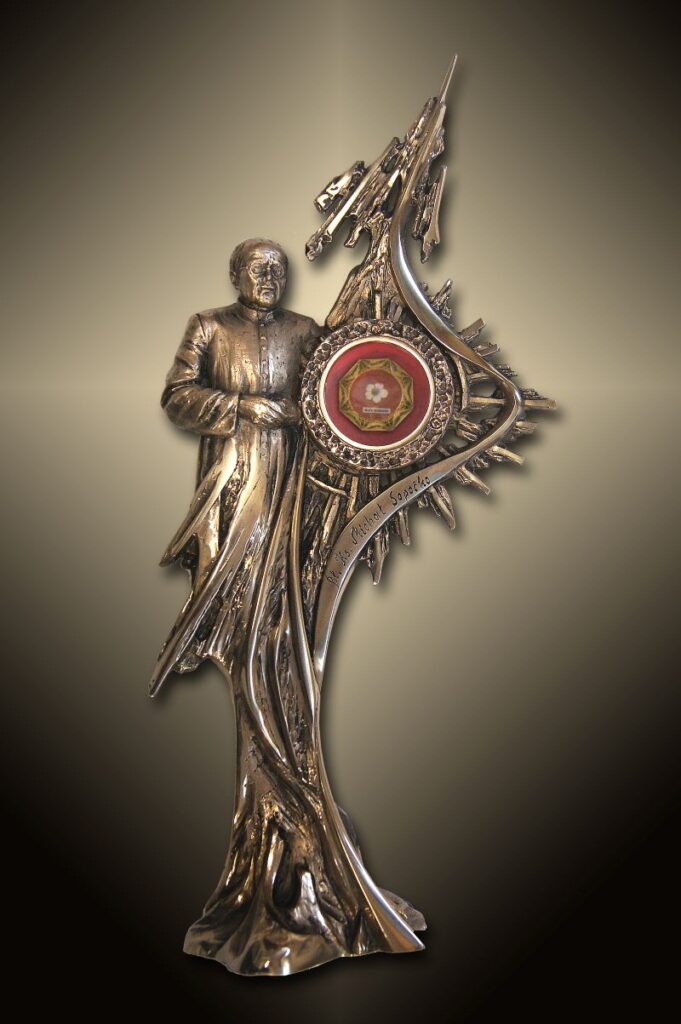
Our sculpture studio often receives commissions that hold immense spiritual value for us. One on these moments was when we were working on a reliquary for the relics of Blessed Father Michał Sopoćko. For many people, he is known primarily for being the confessor of St. Faustina. Who was Father Michał Sopoćko? Today, we know much more about.
Who was Father Michał Sopoćko? Was he only Saint Faustina’s confessor?
Someone could say that Father Michał Sopoćko is a figure standing in Saint Faustina shadow. He is sometimes perceived that way. However, his life and story are very rich and really worth telling. He was not only man of enormous intelligence, but above all, of extraordinary faith and trust in God’s Mercy.
Education in Faith and Early Confirmation
He was born in 1888 in Juszewszczyzna (Vilnius Region). His parents were patriots and cared not only for their children’s education but also for their upbringing in the faith. They prayed daily and traveled regularly to Saint Mass in a town 18 km away. When Michał was less than four years old, he was confirmed. It’s hard to believe, but in those days, a bishop’s visit to the parish occurred only every few years. Michał’s parents traveled by horse-drawn carriage from Nowosad (where they lived) to Vilnius, over 100 km away. Five years after his confirmation, Michał went to confession and a year later received his First Holy Communion.
Father Michał Sopoćko – War and Education
Michał Sopoćko was one of the best students at school. In 1910, he began studies at the theological seminary in Vilnius. Studying, especially for the priest, wasn’t as easy as it is today. Michał Sopoćko often encountered difficulties posed by the Russian authorities. He was ordained a priest on June 15, 1914. Then he was assigned as a vicar to the parish of Taboryszki. In 1918, he was thinking to begin studies at the Faculty of Theology at the University of Warsaw. Unfortunately, his illness and warfare both prevented him from doing so. He volunteered and, despite his own poor health, supported soldiers in a field hospital.
In 1919, the University of Warsaw reopened. Father Michał Sopoćko enrolled in the section of moral theology (he also attended lectures in law and philosophy). In 1932, he earned a master’s degree, and three years later, a doctorate in theology. He completed his habilitation in 1934 at the University of Warsaw. Sopoćko had a talent for learning foreign languages. In addition to English, he also spoke German and French.
Father Sopoćko meets Sister Faustina Kowalska
In 1932, Michał Sopoćko joined the Congregation of the Sisters of Our Lady of Mercy. He became the confessor and spiritual guardian. This time he met Sister Faustina Kowalska, who had been going to confession regularly since May 1933. St. Faustina was convinced that Jesus spoke to her not only directly but also through people, especially her confessor.
Father Michał researched and discerned the messages entrusted to the sister. This discernment fostered in him a vocation to spread them. Therefore, he became a devotee of the Divine Mercy and laid the theological foundations for the devotion. He was inspiration to write the Saint Faustina’s Diary.
Sister Faustina wrote in Diary a promise from Jesus concerning Father Michał Sopoćko:
There will be as many crowns to form his crown as there will be souls saved by this work. It is not for the success of a work, but for the suffering that I give reward. (Saint Faustina’s Diary, 90).
Białystok – the last years of his life
Father Michał Sopoćko spent the last years of life (from 1947 to 1975) in Białystok. When the Vilnius region came under Soviet rule, the Poles living there were forced to flee to Polish territory. Father Michał Sopoćko left Vilnius and went to Białystok. There, he continued his pastoral ministry at the seminary and as chaplain to the Missionary Sisters.
He died on February 5, 1975 at the age of 87. This was the feast day of Saint Faustina, the patron of Saint Faustina Kowalska. Today, in Białystok, we can visit the Sanctuary of Divine Mercy. Moreover, You can find in Białystok pilgrimage and tourist route “In the Footsteps of Blessed Father Michał Sopoćko.” It is interesting way to commemorate this blessed figure.
Beatification of Father Michał Sopoćko
The beatification ceremony took place at the Sanctuary of Divine Mercy in Białystok on September 28, 2008. Archbishop Angelo Amato, delegate of the Holy Father Benedict XVI, presided over the Mass. The homily was delivered by Cardinal Stanisław Dziwisz. The ceremony was attended by the Metropolitan Archbishop of Vilnius, Cardinal Audrys Juozas Bačkis, the Metropolitan Archbishop of Minsk-Mohilev, Archbishop Tadeusz Kondrusiewicz, the Orthodox Ordinary of the Białystok-Gdańsk Diocese. There were also other priests and about 100 sisters from The Congregation of Sisters of Merciful Jesus.
Considering that this holy man left his holy footprints in three independent countries – Belarus, Lithuania, and Poland, he can certainly be called the Patron of Three Nations: Belarus, Lithuania, and Poland. (Address by Archbishop Tadeusz Kondrusiewicz, Metropolitan of Minsk-Mohylev)
Blessed Father Michał Sopoćko – a word from his Diary:
Looking back to my childhood years, I see one continuous series of manifestations of God’s immeasurable mercy. (…) And it is to God’s mercy that I owe most of all my priestly vocation, which I felt quite early on, the maintenance of this desire despite so many obstacles, and the guidance I received through numerous trials in which I would surely have fallen and perished, had not the Creator’s compassion sent me clear help from above. (…) Therefore, I would be the most ungrateful person if I still belonged to myself and wanted to seek myself in any action, word, or thought. Trust in God’s continued mercy, spreading the devotion to this mercy among others, and limitlessly devoting all my thoughts, words, and deeds to it without a shadow of self-seeking, will be the guiding principle of my future life with the help of this immeasurable mercy.
The following materials were used to prepare this article:
- Address by Cardinal Audrys Juozas Bačkis, Metropolitan of Vilnius, http://sopocko.pl/beatyfikacja/7-wystapienie-kard-audrysa-juozasa-backisa-metropolity-wilenskiego/
- Fr. Henryk Ciereszko, “The Path of Holiness of Father Michał Sopoćko”, http://sopocko.pl/artykuly/9-droga-swietosci-ks-michala-sopocki/
- “In the Footsteps of Father Sopoćko”, https://www.idziemy.pl/kosciol/sladami-ksiedza-sopocki/66494
- Information from the website of the Sanctuary of Divine Mercy in Białystok, https://milosierdzie.archibial.pl/
- Roman Catholic Parish of the Blessed Virgin Mary of Perpetual Help – archival materials, http://www.mbnp.archidiecezja.wroc.pl/?page_id=4785
- Breve announcing Father Blessed Michał Sopoćko, https://kkbids-old.episkopat.pl/uploaded/a61/Anamnesis61-1estr.18-19.pdf
- Białystok Pilgrimage and Tourist Route “In the Footsteps of Blessed Father Michał Sopoćko” https://szlak.archibial.pl
We recommend similar articles:
Father Leon Dehon – Initiator of a Great Work
